

The Silent Hunger
My 24/7 Home Negotiation

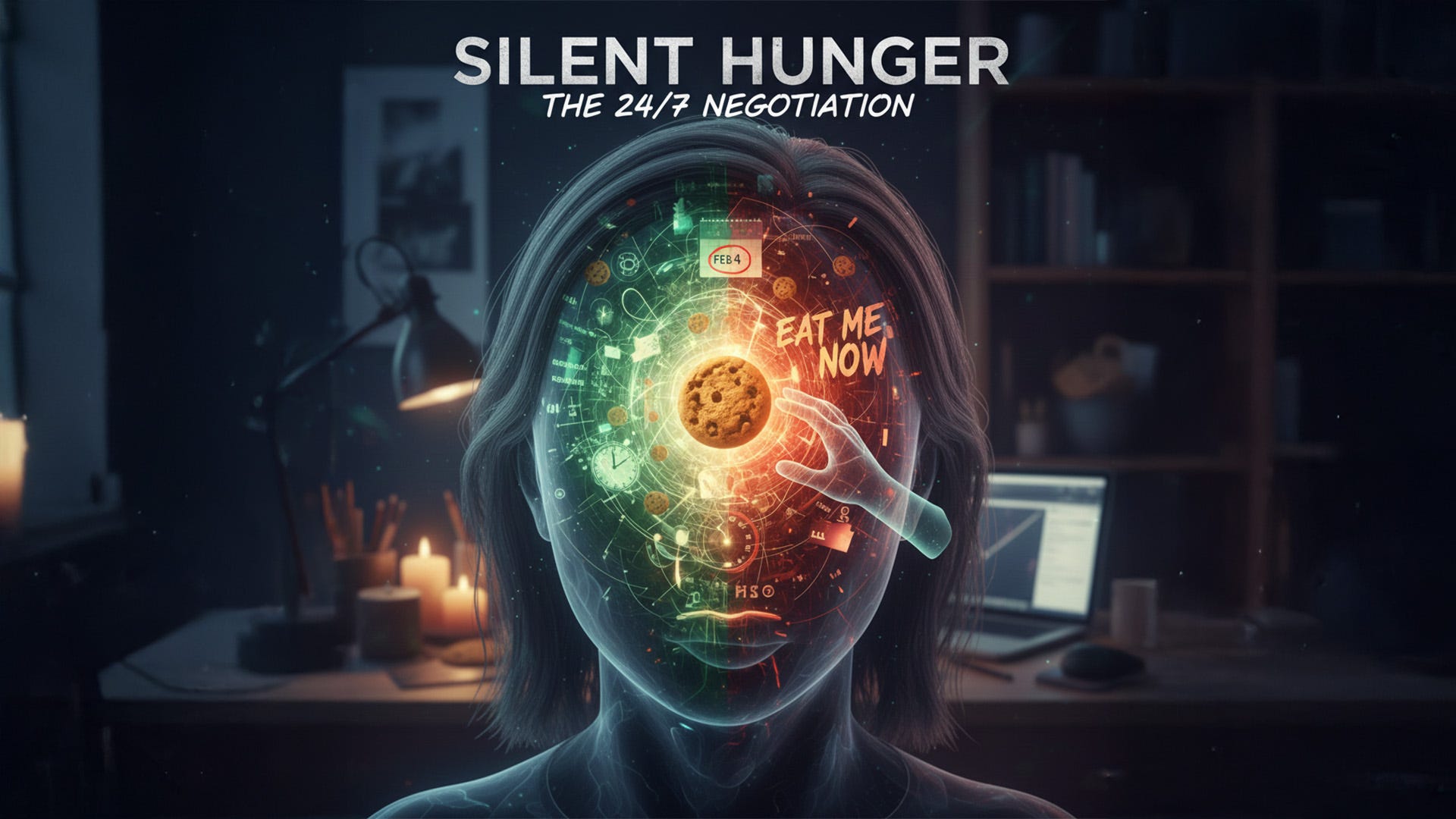
The house is quiet, save for the hum of my computer and the soft crackle of a candle on my altar. My husband is in the other room, likely settled into a book or a show, completely unaware that a mile-wide war is being waged just twenty feet away in the kitchen. On the counter sits a container of cookies.
To a “normal” person—the kind of person like my husband, who can eat one cookie and then literally forget the rest exist—those are just snacks. They are flour, butter, and sugar. But for me, they are a pulsing frequency. Even through the walls, I can feel their presence. It’s a magnetic pull that tugs at the back of my skull while I’m trying to focus on my work.
My inner monologue isn’t a stream of consciousness; it’s a high-stakes hostage negotiation that never ends.
The False Equilibrium
“Okay, you’re fine. You have three readings to get through and that article is due by tomorrow morning. Focus on the energy. You are centered. You do not need a cookie. You’re working with Spirit and Intention right now. Stay focused; don’t muddy it with a sugar crash. Just finish this cleansing for this lovely person and stay in the zone.”
This is my first stage: Rationalization. It’s my attempt to use my craft and my logic to douse a fire fueled by dopamine receptors. I know, intellectually, that I am not hungry. I had a solid lunch. But my brain is sending a signal that feels like a survival instinct. It’s a frantic, urgent pay attention to this signal that drowns out the supportive emails I’m trying to draft.
The realization is always the same: Normal people do not do this. They don’t have a mental sonar system constantly pinging the exact location of a chocolate chip.
That thought is the cruelest of all. While I’m trying to channel clarity for a client, I am secretly calculating the distance between my desk and the kitchen counter.
The Bargain
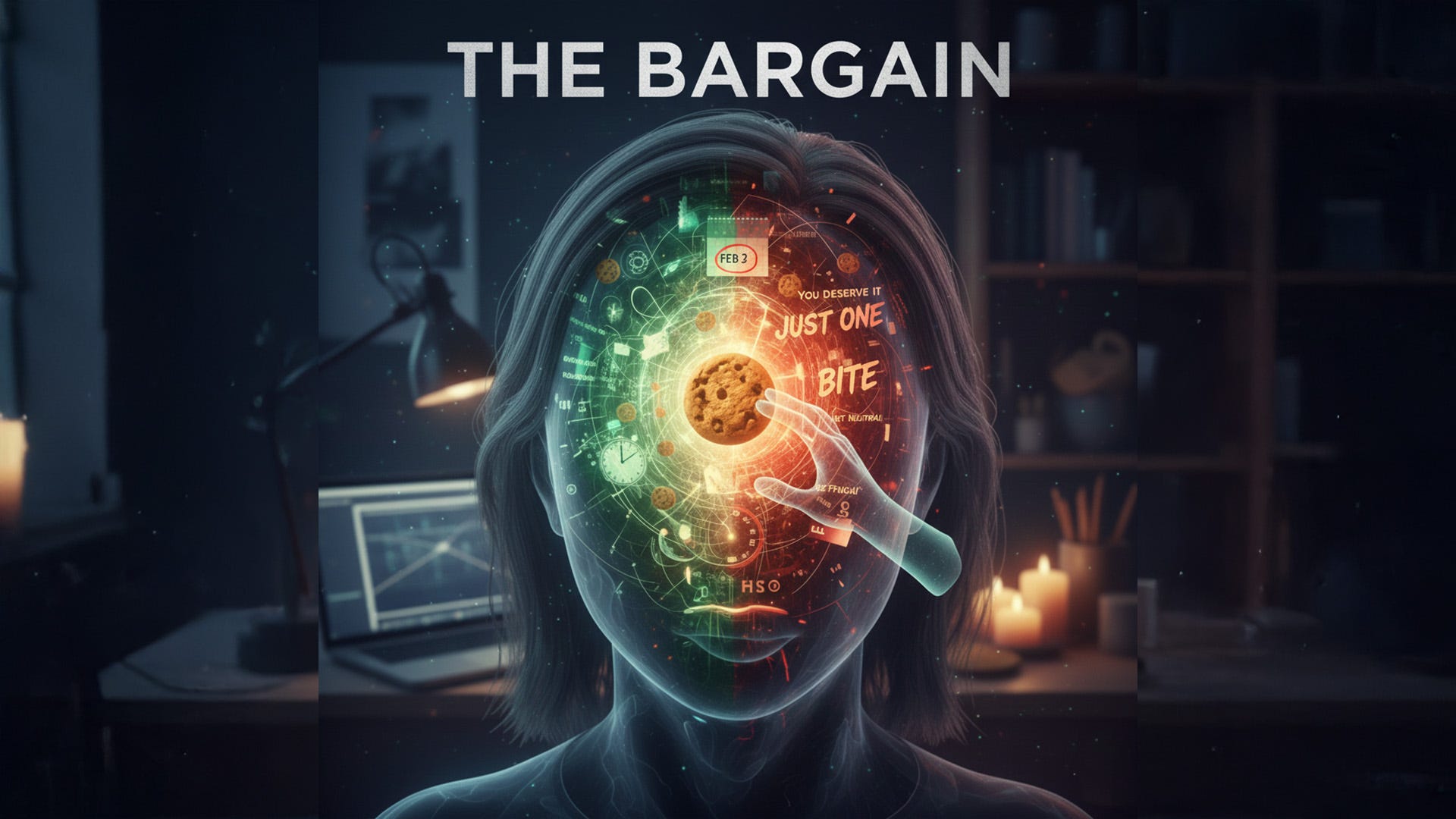
I finish an email. My “rational” self is losing ground. The “Addict” in me—the one that lives in the basal ganglia—begins the process of the counter-offer.
“You’ve been working hard. You’ve cleared so much heavy energy for other people today; you deserve a little grounding. Sugar is grounding, right? Just take one. If you take one now, you won’t want any after dinner. It’s actually more efficient to eat it now so you can stop thinking about it and finally finish that article. It’s a productivity tool.”
The bargain is a masterpiece of self-deception. It ignores my own historical data: I have never, in my life, stopped at “one” when I’m in this headspace. But my addicted mind has a convenient form of amnesia. It treats this specific craving as a vacuum-sealed event, disconnected from the dozen times I’ve done this exact dance before.
My Comparison Trap
I hear my husband walk into the kitchen. I hold my breath. I hear the lid of the container clink.
That f***er is eating my cookies!
He’s getting one... Just one. Pfft, amateur.
I hear him walk back to the living room. He isn’t lingering. He isn’t standing over the container like it’s an altar. He just... took one.
“How does he do that?” I wonder, my fingers hovering over the keyboard. “How is he not vibrating? How is he not thinking about the fact that there are exactly eleven cookies left? HOW IS HE ALREADY BACK READING HIS BOOK AND NOT CELEBRATING THIS VICTORY?”
To me, “normal” eaters look like magicians. They possess a superpower called Satiety. My “off” switch is broken. Eating doesn’t make my craving go away; eating is the starter pistol. One cookie doesn’t satisfy; it merely validates my brain’s demand for the rest of the container.
The Pivot: From Desire to Obsession
I try to dive into a spellwork session. I’m lighting incense, refocusing my intent, but the cookies are screaming louder than my own intuition.
“Just go get it over with. This is interfering with your work. You owe this to your client. Walk into the kitchen, take two, and bring them back to the desk. Don’t eat them over the counter as if you stole them. You’re a grown-ass adult in your own home. You are stronger than a snack. Just get two and that’s it. Then you can focus.”
I stand up. I tell myself I’m just going to get more water.
“But if you only take two, you’ll just be back here in twenty minutes. Why not take three? Three is a powerful number. Magical, even. A sacred number. It’s symbolic. Take three and call it a day. If you don’t take them now, Eric’s going to eat them and not even truly appreciate them. Then you will seriously be pissed. You’re actually protecting your resources. If you eat them now, you are practicing pre-emptive self-care.”
I walk to the kitchen. I don’t even use a plate. I take three. I wrap them in a paper towel like they’re contraband. As I walk through the living room, passing in front of his chair, I keep the precious package in my left hand, down at my side, so he is less likely to see them. My Higher Self slowly shakes its head and facepalms. How has it come to this?
The White-Knuckle Desk Session
Back at my desk, the cleansing I start for my client feels like a hypocrisy. I’m trying to clear their energy while my own is becoming dense and frantic. So I wait, breathe, and get back into my body.
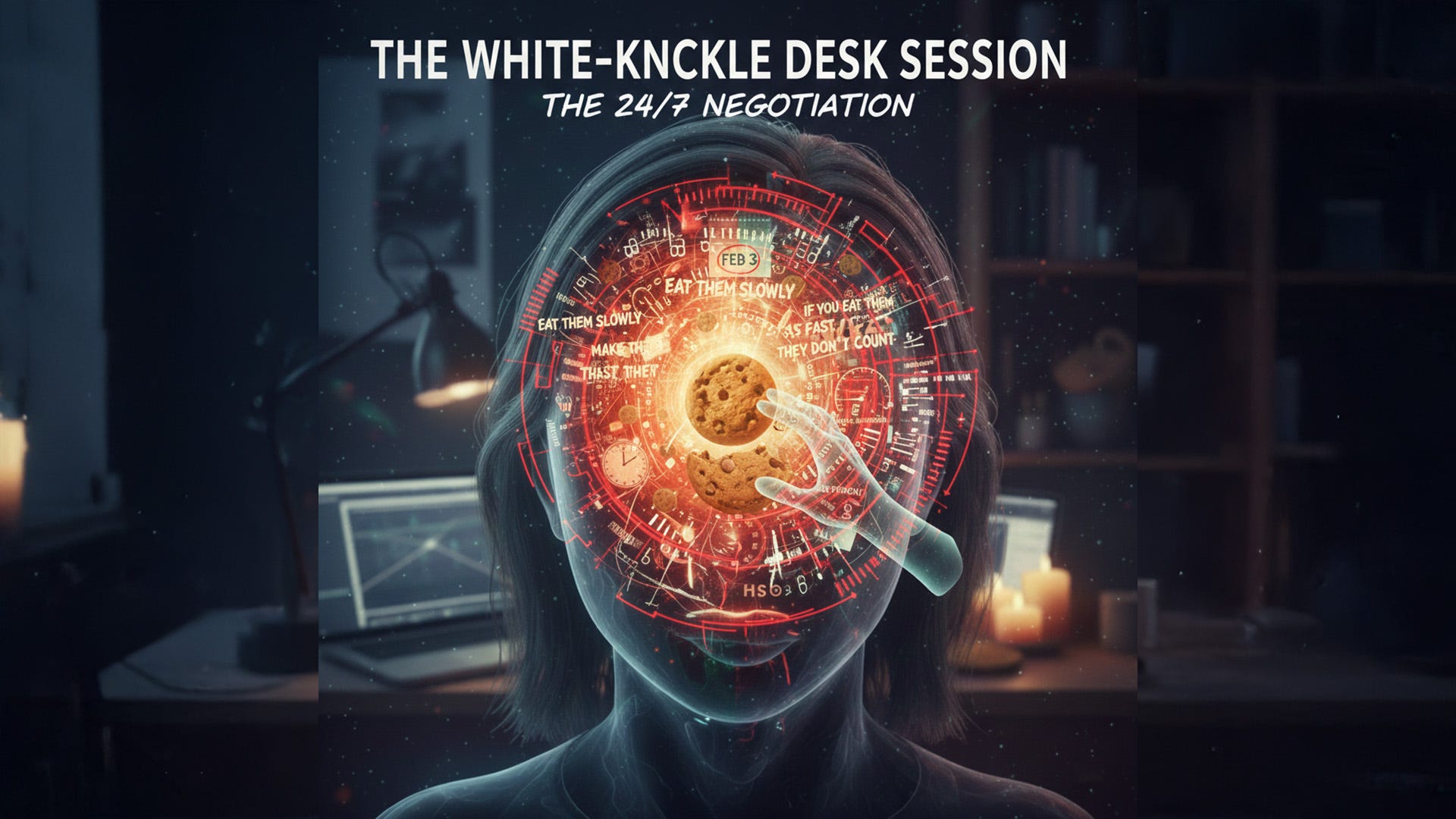
“Eat them slowly. Savor them. Make them last.”
“If you eat them quickly, on the other hand, they don’t count.”
I take a bite. The explosion of glucose hits my system, and for exactly four seconds, the screaming stops. There is peace. There is a warm, velvety blanket draped over my anxiety. The frenetic inner dialog goes silent. My brain instantly and finally feels “quiet.”
Then, the After-Burn kicks in.
“Well, you’ve already messed up the ‘clean’ energy of the room, didn’t you? You can’t do a proper reading now with all that sugar in your blood. You might as well finish the container since the next hour is already compromised. If you’re going to fail, fail big. Make it worth the guilt.”
The Loneliness of My Loop
This is the “All-or-Nothing” fallacy that defines my relationship with food. There is no middle ground. There is only the “Clean Energy” of success or the “Bottomless Pit” of failure.
By the time my husband comes in to ask if I’m ready for dinner, the container is significantly lighter, and I am stuffed with a heavy, leaden shame that sits in my gut as heavily as the cookies will sit on my hips.
“Are you ready for some salad and chicken?” he asks.
“Not really,” I say, my heart hammering against my ribs from the sugar spike, my mind cloudy where it should be sharp for my clients. “I’m just really deep into this article. I’ll eat later.”
It isn’t a lie, after all.
The Aftermath: My “Normal” Ghost
As I lie in bed tonight, the dialog hasn’t stopped; it has only changed its tone. It has shifted from Seduction to Persecution.
“What is WRONG with you? You spent most of your workday—time you should have spent helping people or writing—negotiating with a pile of sugar and now you are exhausted from the sheer effort of it. You sort of maybe but not lied to your husband. You’re a literal slave to a sensation, flavor, and texture. Normal people do not do this. They focus on their craft, their partners, their growth. You think about the kitchen. You can’t enjoy an activity that does not come with some sort of catering. You strategize about when you can eat next and what it will be. For you, being present is stolen by obsession. This simply must stop.”
This internal cacophony is exhausting. It is a mental marathon run in a dark room. People see an arguably successful person doing readings and writing articles, but they don’t see the sheer volume of intellectual and emotional labor I spend trying—and failing—to be “normal.”
I am not someone who loves food too much; I am someone who is being chased by a starving, frenzied ghost, even while I’m trying to walk a spiritual path; a ravenous wraith that can never be satisfied.
Understanding My Mechanism
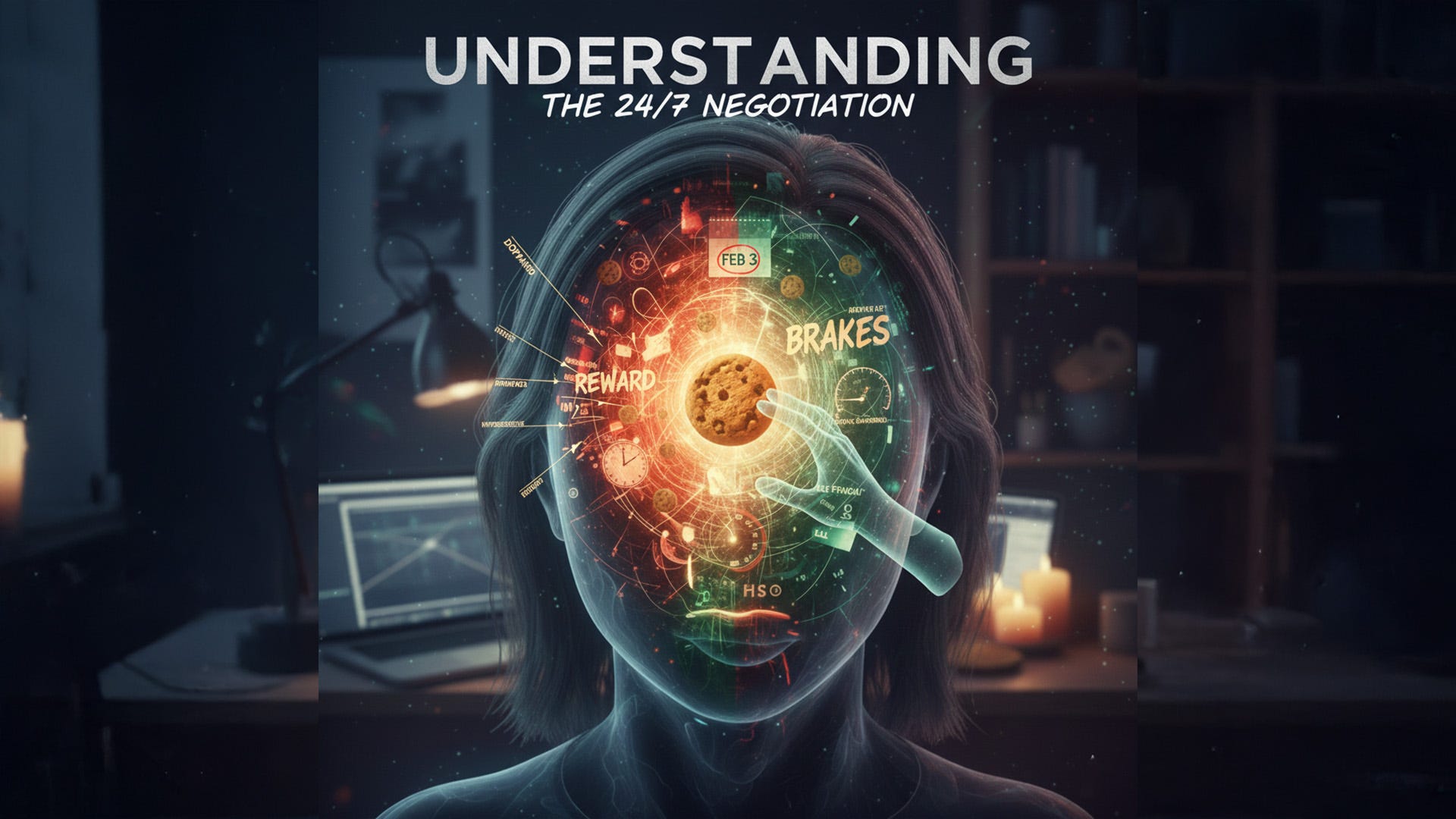
I try to remind myself that this frenetic dialog isn’t a character flaw or a spiritual failing; it is a neurological misalignment. In my brain, the reward circuitry is hypersensitive, while my “brakes” are dampened. I let science soothe my guilt.
Cue Reactivity: The mere knowledge that those cookies are in the kitchen triggers a dopamine surge before I even smell them.
Delayed Satiety: My “I’m full” hormones are being shouted over by a brain screaming for a “reward” hit to cope with the stress of my work. In short, my shit is broken.
The Shame Cycle: My shame creates a “heavy” energy, and my brain’s quickest way to lighten that load is—ironically—more sugar, delicious breads, savory meats, and salty nibbles.
The Shame Cycle Is Really a Trauma Cycle: People are not born this way. It is a coping mechanism developed in response to trauma, when everything and everyone around them lets them down but food never does. Now, I have so many people in my life on whom I can depend to be there for me. For most of my life, I did not have that and this… this… thing is a result of that. Forgive yourself for responding to trauma. Forgive yourself. Forgive yourself. Be gentle with you.
My Path Toward Quiet
I am learning that my willpower is a finite resource. It’s like trying to use a candle flame to light up a whole cavern. At this point, I mostly don’t have any and can go from, “I don’t need that buttered roll” to “Screw it, get two” in sixty seconds.
My goal isn’t just to “stop eating cookies.” My goal is to lower the volume of that inner monologue so I can actually hear my own intuition again. I come up with a solid plan and that looks like:
Sacred Space Boundaries: Keeping trigger foods out of my workspace entirely. One would think, huh? That part should be easy, but even grocery shopping starts that process outlined earlier in this article. In truth, it is like trying to shop in a grocery store with a preschooler who wants everything hanging on your leg… and now, even in my remote location, I can have it delivered in an hour or so.
Radical Honesty: Telling my husband when the “noise” is getting loud so I don’t have to carry the secret. That starts with being honest with myself. At this point, neither he nor I believe me when it comes to food. My stabs at “radical honesty” are as frail as a New Year’s resolution.
Protective Rituals: Creating a “pre-work” routine that addresses my brain’s need for dopamine through healthy movement or music instead of sugar. Yeah, that’ll happen.
I lie here in the dark and promise myself that tomorrow will be different. I try to imagine a world where a cookie is just a cookie—a world where my mind is finally my own again. It’s a long road, but I’m starting to realize that the voice in my head isn’t “me”—it’s just the addiction, and I don’t have to let it have the final word over my life or my craft.
Today, however, was apparently not that day.
And in support of “radical honesty,” tomorrow ain’t looking great either.