

The Silver Storage Unit
Surviving the Grey Tsunami

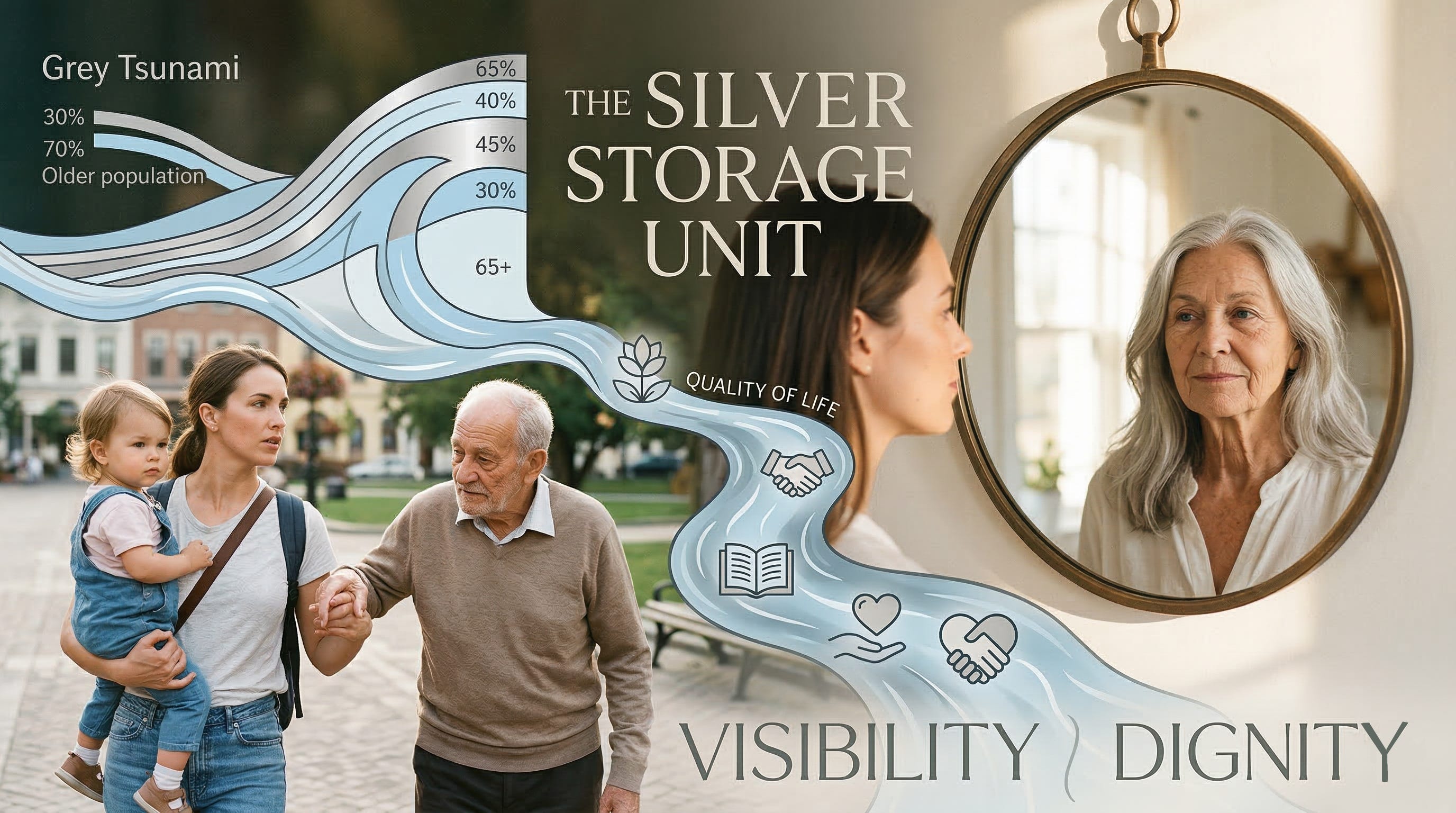
In the lexicon of demography, they call it the “Grey Tsunami.” It’s a clean, clinical term for a messy, human reality: the Baby Boomer generation is aging out. Thanks to the miracles of modern medicine and the fact that we’ve mostly traded manual labor for ergonomics, people are living longer than ever before.
But here is the irony of our “Body of a Goddess” pursuit: we spend our entire lives worshipping the maintenance of the vessel—the skin, the muscle, the longevity—only to find that society has no idea what to do with the vessel once it hits its eighth or ninth decade.
The Mirror of Mortality: Why We Look Away
Why do we warehouse our elders? Where do we warehouse our elders? Why has the “elder” role become something we contemplate with a shudder rather than a sense of arrival and reverence?
The truth is uncomfortable: We are terrified of them because they are a mirror. When we look at a person in their 80s or 90s, we don’t see a human being with a lifetime of stories; we see a “future self” that we have been conditioned to fear. In a culture that fetishizes youth, an aging body is seen as a failure of will. We’ve been sold the lie that if we just eat enough kale, lift enough weights, and buy enough serum, we can opt out of the breakdown.
But the unavoidable reality is that there are only two paths in this life:
You age. Your skin loses its elasticity, your gait slows, and your role in the “productive” economy fades.
You die young. That’s it. That is the binary. You do not get another choice. Yet, we treat the first option—the one that represents the literal success of our biology—as a tragedy. We have made the elder role so uncomfortable to contemplate that we would almost rather ignore the reality of it until it’s too late. By pushing the elderly out of sight, we are trying to push our own mortality out of mind. We aren’t just neglecting them; we are practicing the neglect of our future selves.
Currently, only about 40-45% of seniors in assisted living report a high "Quality of Life" score regarding social connection and purpose. That gap exists because by pushing the elderly out of sight, we are trying to push our own mortality out of mind. We aren't just neglecting them; we are practicing the neglect of our future selves
Where Are We Piling the Bodies?
When we talk about the “Grey Tsunami,” we have to ask where the water is going. Right now, it’s being diverted into a fragmented, profit-driven labyrinth of assisted living facilities and nursing homes that often feel less like communities and more like waiting rooms.
We have a habit of “warehousing” the elderly. We tuck them away in beige corridors where the air smells like industrial lavender, pee, antiseptic, and regret, hidden from the sight of the young. We’ve commodified aging to the point where “care” is often reduced to a checklist of medications, completely ignoring the goddess within—the spirit that still craves agency, beauty, and touch.
The Sandwich Squeeze
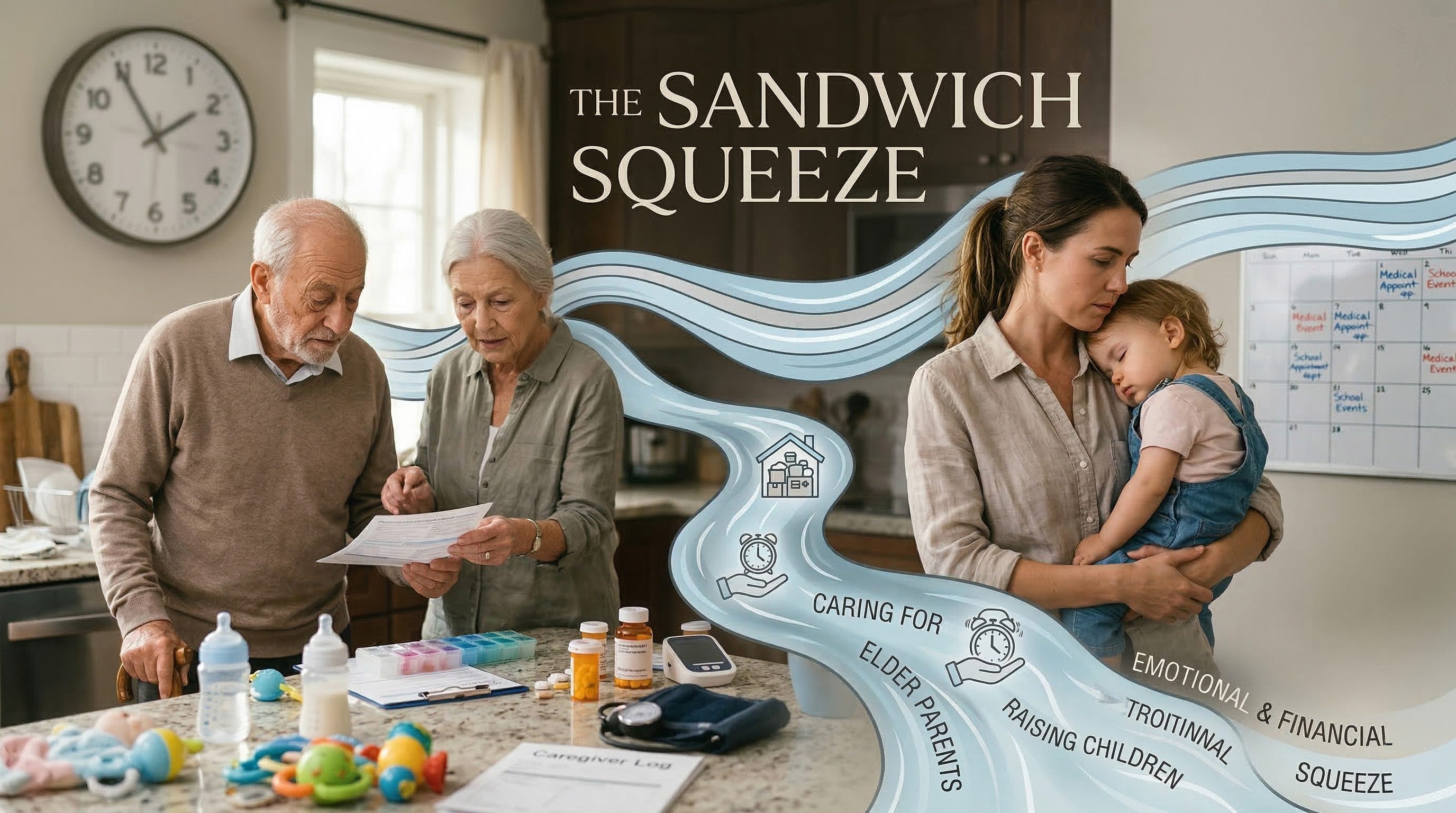
For many, the solution isn’t a facility; it’s the home. This has birthed the “Sandwich Generation”— 65% of middle-aged adults now pinned between the needs of their aging parents and the demands of their own children.
It is a grueling cycle of changing diapers at both ends of the age spectrum. I speak from a strange place of observation here; my parents and in-laws died young. I escaped the “sandwich,” but I feel the weight of its absence. Because if I am lucky—if I am truly, biologically fortunate—my children will eventually have to care for me. To be cared for by your children is a privilege, but in our current society, it’s also a burden we haven’t taught our children how to carry.
Of course, the more money you have the less of a problem this becomes. When you can hire staff to take care of Gram in Downtown Abbey, you aren’t feeling that Sandwich Squeeze (or any other squeeze) choking the life out of you. For most of us, however, the concern is real.
If we had a great childhood and adore our parents, we glamorize the idea of, “Dad will just come live with us when he can no longer take care of himself.” That’s a fantastic solution when it works, but even the best dad on earth can be difficult to care for when he’s throwing dinner plates and peeing in the neighbor’s flower bed every morning.
Then we have that significant cohort of people who had less than supportive childhoods and must contemplate navigating elder parent care around a toxic dynamic they have endured for decades.
The Math of Neglect
We see the waves coming, but do we understand the volume?
70%: The projected growth of the 65+ population in the next two decades. In many developed regions, we are rapidly approaching a reality where for every 100 people, a massive chunk is shifting into the senior category, while the birth rate—represented by that smaller 30%—is failing to keep pace. This creates an inverted pyramid. We have a top-heavy society where the few (the young) are expected to support the many (the elders).
65%: This often refers to the projected percentage of "Sandwich Generation" members who feel significant financial or emotional strain. It’s a reflection of the fact that over two-thirds of people in that middle-age bracket are currently providing some form of unpaid, intense labor for both a child and a parent.
The 40-45% Quality of Life Gap: This is perhaps the most sobering stat. It reflects the percentage of seniors living in "clinical storage" who report feeling a lack of daily purpose or social connection. It’s the gap between being medically stable and actually being alive.
30%: The shrinking percentage of the workforce available to actually staff the facilities we’re piling people into.
How to Teach the Heart to Care
How do we move from piling people up to actually integrating them?
Visibility as Resistance: We have to stop looking away. Reintegrating the elderly into daily life—parks, schools, town centers—forces us to confront our own timeline.
Aesthetic of Dignity: We must demand that elder care be designed for living. Natural light and intergenerational programs (sharing space with daycares) should be the standard.
Exercising the Empathy Muscle: We teach our kids how to code, but we don’t teach them how to sit with the elderly. Empathy for the aged is a muscle that must be trained.
The Final Act
The “Grey Tsunami” isn’t a disaster; it is the natural, desired result of a long life. We need to stop treating the elderly as a problem to be solved and start treating them as the goddesses they are—just in a different phase of the moon.
If we want our children to care for us with grace, we have to build a world that values the body at every stage of its journey.